

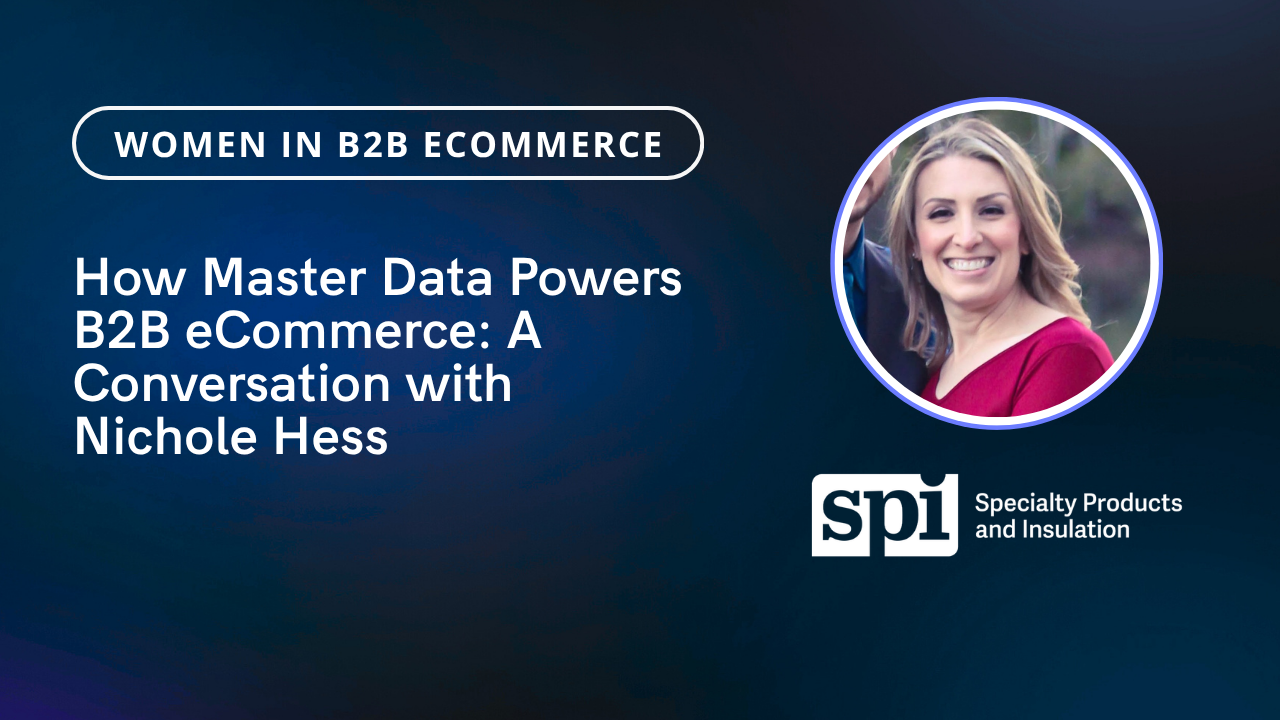
Master Data Powers B2B eCommerce for Manufacturers and Distributors: A Conversation with Nichole Hess
May 11, 2026

Founder & Director · B2B eCommerce Association
For nearly two decades, Nichole Hess has been quietly building the layer that everything in B2B eCommerce sits on top of: clean, governed, trustworthy product data. Today, as Senior Manager, Master Data at SPI (Specialty Products and Insulation), she leads the practice that lets a sprawling distribution catalog show up correctly in search, navigation, and the buyer’s cart. Her path from the floor of a Target store to the data governance lead role at one of North America’s largest specialty distributors is also a story about how the hidden architecture of B2B digital commerce gets built, and who builds it.
From Retail Buyer to Data Governance Leader
Hess started her career working in a Target store, decided corporate retail was a better fit, and joined Belk’s Charlotte headquarters as a merchandise assistant. She moved up to assistant buyer, then pivoted into eCommerce when a former vendor pulled her into the team building out Belk’s online product data operation. By the time she left, the retailer’s online business had crossed a billion dollars.
“I have been in retail in some form or fashion for about 19 years,” Hess said. The buying-side experience gave her a frame of reference that has shaped every role since. “I was really in the industry long before I really knew how foundational data really came to be this digital success.”
That foundational layer, often referred to as master data or golden records, is what governs how every product is described, attributed, and surfaced across an eCommerce site. For distributors carrying tens of thousands of SKUs across categories like insulation, fasteners, and building products, the discipline is the difference between a usable catalog and a frustrating one.
Why Product Data Defines the B2B Customer Experience
Hess’s central conviction is that customer experience in B2B eCommerce is, at root, a data problem. There is no salesperson at the digital shelf, so every attribute, every taxonomy choice, and every search synonym has to do the selling.
“The quality of the data really directly determined the quality that your customer was going to experience,” Hess said. “Online, you’re not going into a brick and mortar store where you have that salesperson right there that can tell you all about these items. So I’m trying to tell this customer in the taxonomy where they’re going to go. I’m trying to tell them in the search and nav, making sure that if they type in KitchenAid they’re going to be able to get to what they need to, or stand mixer, from an SEO perspective.”
Hess has watched the connection click for non-data colleagues over and over. “Your search accuracy, your navigation, your conversions, all that, it all comes back down to the data and all the things that you put into it, and how important those master and golden records really are.” Her practical examples land especially well in distribution, where attribute consistency on units of measure, dimensions, and material specifications is what keeps a faceted search usable. As the B2B eCommerce Association has argued in its analysis of why the PIM decision looks nothing alike for manufacturers and distributors, the underlying data problems differ between the two sides of the supply chain, but the cost of getting it wrong is the same.
The AI Leap Forward in Master Data Management
When Hess looks at what has changed in product data work, the contrast is striking. Early in her career, attributing inventory meant carrying physical garments to an on-site photo studio with paper tags tied to the handles, then scrolling through Excel spreadsheets row by row to normalize the results.
“I think back to some of the Excel spreadsheets that I had way back, and I’m like, oh my gosh, how did we even operate this way,” Hess said. “I remember just manually going through and searching. We would dump all the data into an Excel file, and we would just, again, it was just row by row by row. Now you just think, I could have just thrown that in ChatGPT or Claude or something, and that would have been done instantaneously.”
That leap is the opportunity she sees as most consequential, both for incumbents and for businesses earlier in their digital journey. The new mandate is to keep learning. “It would behoove all of us to take 10, 15 minutes every morning or at the end of every day to go online and just learn and stay abreast as to what’s out there.” She uses AI tools to compress what used to be week-long data hygiene jobs into hours. “From a governance standpoint, we can normalize data so quickly. We can upload spreadsheets of information, and get through cleaning up data. It’s crazy what all these AI tools are capable of doing.”
Navigating Male-Dominated Industries
Moving from department store retail to industrial categories like insulation and fasteners meant moving into industries where Hess was often one of very few women in the room. Her experience has been better than many practitioners describe, and she credits that partly to the people around her and partly to the cross-functional skills she brought.
“I have actually been fortunate enough that a lot of the male counterparts that I have worked with have invited me very well,” Hess said. “They have always been very welcoming as far as trying to teach me what I don’t know.”
She also believes there is a structural advantage women bring to this kind of work. “Women really excel at cross functional communication and relationship building. Those strengths help me drive alignment, and also help build those relationships with the male counterparts. In the corporate environments, being a woman, we can drive alignment across IT, merchandising, operations, leadership.”
Mentorship That Moves the Needle
Hess’s most vivid leadership story is about a former boss who has since become a long-term mentor.
“She is an advocate for women in a very big way in the workforce, and she is about making sure that women are seen and heard,” Hess said. “She makes sure that we get what we deserve, and I will forever be grateful for that.”
Concretely, that meant fighting for pay equity and for performance-linked raises that the company would otherwise have flattened across the team. “She made sure that everybody on our team was getting paid what we deserved. There was a lot of people that weren’t getting what they were supposed to be getting paid, and she fought hard, and she advocated for us, which I thought was just tremendous.” When the company set a uniform raise pool, the same manager went to bat individually. “If somebody did a big project or they took on a lot for the year, she made sure you got the raise that you deserved. And if she couldn’t give it to you that way, she gave it to you in your bonus.”
The willingness to spend that capital, Hess said, is what separates real advocacy from the performative kind. “There are a lot of people that can say I’m going to do X, Y, and Z, but then you don’t see them even try. She not only tried, but she actually made things happen. That’s refreshing.”
Advice for Women Building Careers in B2B eCommerce
For practitioners who want to move into data governance, master data, or digital transformation work, Hess offers four pieces of advice that map closely to the skills hiring managers in this space tend to under-value.
First, learn the business. “You definitely need to learn the business 100 percent. Learn it from the ground up. Learn as much as you can. Ask questions. There’s never a dumb question.”
Second, learn the data at its foundation. The downstream use cases (faceted search, dynamic pricing, inventory accuracy, analytics) all draw from the same source. “When you even just talk about ship-to data, you don’t realize how many points that touches in a company.”
Third, speak up when something does not make sense. “If you don’t speak up then you’re not going to understand it, and what if you’re in the room and you just act like you understand it, and then it builds upon something else. The more questions you ask, the more times you say, ‘Hey, that didn’t make sense,’ the more valuable you’re going to be seen.”
Fourth, build the relationships. Governance is a trust function, not just a logic function. “Governance and digital transformation are very successful when people trust you. People have to trust you, because governance does come down to trust as well. We’re entrusting you with this data, and to make these decisions.”
Joining the Women in B2B eCommerce Community
Hess attended the B2B eCommerce Association’s Women’s Leadership Dinner in Scottsdale in 2025 as part of the B2B eCommerce World Americas program, and described it as one of the most valuable parts of the conference. “I just love when women can get with other women, and we can really network and build those relationships, and talk with each other. There’s no lost time when we do that. It’s all valuable.”
The B2B eCommerce Association runs a year-round Women in B2B eCommerce program with podcast episodes, dinners, and a peer community of practitioners working in product data, eCommerce strategy, marketing, and digital transformation across manufacturing and distribution. Practitioners can join the conversation in the Women in B2B eCommerce LinkedIn group, and follow the next set of events tied to B2B eCommerce World.
For Hess, the work is its own reward. “I never would have thought in a million years I would be here today doing data governance. It’s so interesting, but it also very much aligns with who I am. I’m very type A. I like things to have a place. I like stuff to be very organized. So it actually very much makes sense with who I am.”
That alignment, between the discipline a job requires and the person doing it, is part of what she wants more women entering the space to know. The category is wide open, the tooling has never been more capable, and the people building the data spine of B2B eCommerce are setting the conditions for everything that runs on top of it.