

Can AI Agents Find Your Products? Why B2B Manufacturers and Distributors Need to Pay Attention
AI assistants are introducing a new layer between buyers and suppliers. For manufacturers and distributors, the question is simple: will your products show up when an AI agent recommends suppliers?
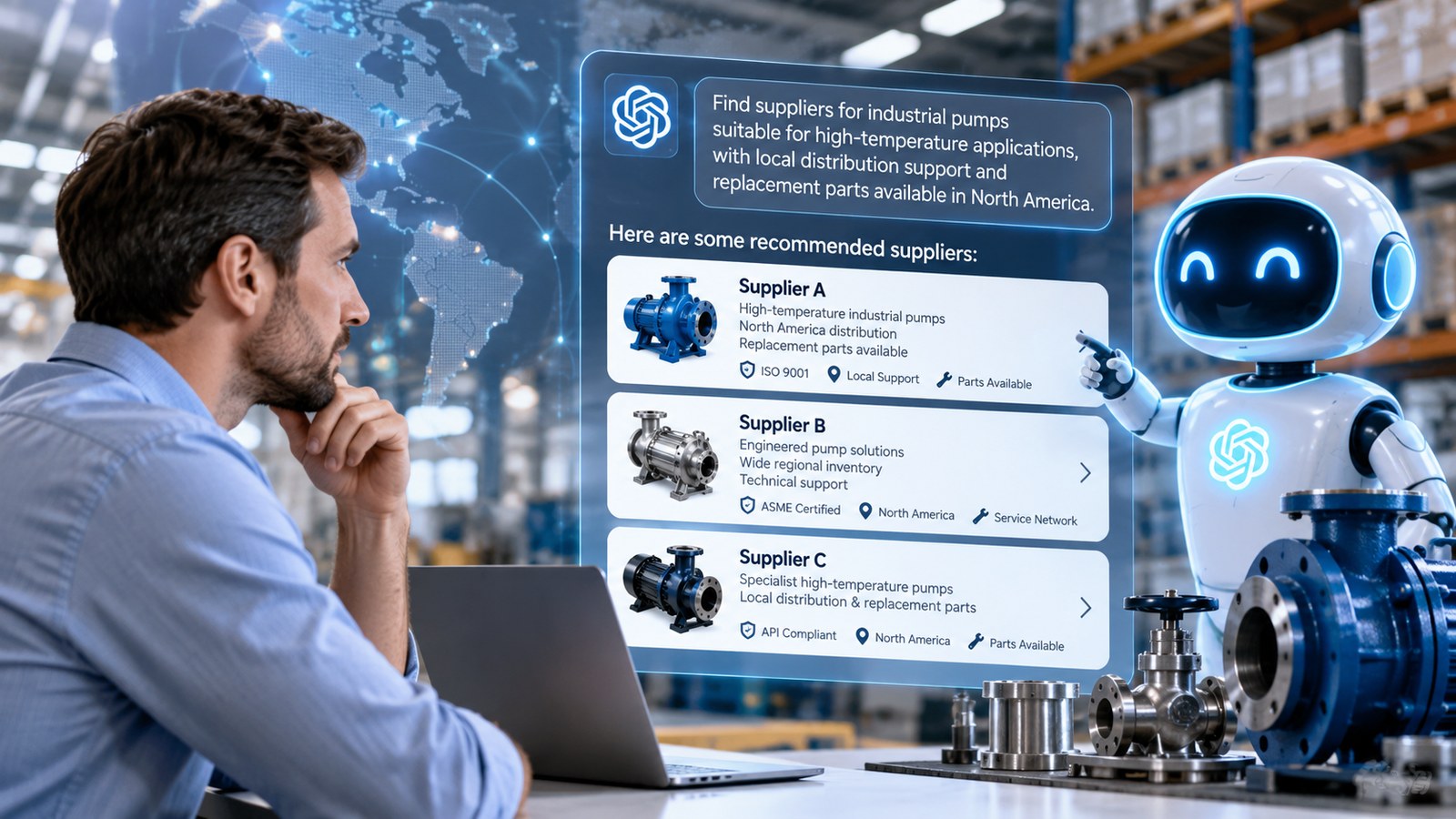
Imagine your customer looking for a new supplier of industrial equipment, replacement parts or specialist components.
Rather than visiting Google or searching through supplier websites and downloading product catalogs, they open ChatGPT, Gemini or another AI assistant and describe what they're looking for, outline their technical requirements and ask for recommendations — within seconds, the AI assistant produces a shortlist of suppliers, compares their offerings and explains which products might be the best fit.
The moment of truth is whether your company's product shows up. If not, you have a problem with a new generation of non-human buyers — AI agents who are programmed to complete a task, no matter what.
The question for manufacturers and distributors is simple: whether or not your business will be part of the AI-led transformation of B2B digital commerce?
This is becoming an important consideration for B2B businesses as artificial intelligence (AI), specifically agents anchored by LLMs, changes how customers research products, evaluate suppliers and make purchasing decisions. And perhaps more importantly, will the AI assistant have enough accurate context about your products to be found by AI agents?
Your Next Website Visitor Might Not Be Human
For years, manufacturers and distributors have invested in making their websites easier for customers to find and navigate.
Search engine optimization (SEO), digital catalogs, product information management (PIM) and ecommerce platforms have all played an important role in helping buyers discover products online. But the way buyers access that information is changing. Increasingly, customers can ask an AI assistant to do much of the research on their behalf.
Instead of browsing multiple websites, a buyer might ask:
"Which manufacturers supply industrial pumps suitable for high-temperature applications, with local distribution support and replacement parts available in North America?"
An AI agent can interpret those requirements, gather information from different sources and recommend potential suppliers. The buyer may receive a useful answer without ever visiting a manufacturer's website. For B2B businesses, that creates a new challenge.
Your website might contain an extensive product catalog, detailed specifications and years of technical expertise. But if an AI agent cannot find, interpret or contextualise that information for LLMs to produce output, then your products may be overlooked.
And when a competitor appears in the recommendation instead, you might never know that a potential sales opportunity may have been missed.
SEO Still Matters, But AI Discovery Is Different
Traditional SEO has focused on helping websites appear prominently in search engine results. You may have encountered terms such as Answer Engine Optimization (AEO) or Generative Engine Optimization (GEO). AI-powered discovery introduces another consideration: whether your business and products are included in the answers generated by AI assistants.
While the terminology continues to evolve, the underlying objective is straightforward.
Make it easier for AI agents to "discover, understand and accurately recommend" your business.
This doesn't mean traditional SEO is becoming irrelevant. A well-structured website, useful content, credible external references and accessible product information remain important for a web store front — but they are meant for humans, hence the term "user experience". In this case the "user" is not human — an AI agent does not care what your website looks like.
AI discovery is not simply about ranking for a particular keyword. A B2B buyer might ask a highly specific question combining product specifications, industry requirements, geography, certifications and service expectations.
For example, a distributor might not rank highly for a broad search such as "industrial valves." But it could be a highly relevant recommendation when a buyer asks for a supplier of a particular valve type, suitable for a specific application, with regional inventory and technical support. This creates opportunities for specialist manufacturers and distributors whose expertise may not always translate into strong rankings for broad search terms.
How AI Decides Which Suppliers to Recommend
One of the challenges with AI discovery is that the process isn't always visible to the business being evaluated. Depending on the AI system and its available tools, an answer may draw on existing model knowledge, live searches, company websites and third-party information. A useful way to understand the process is through four stages:
- Existing knowledge — an AI model may already have information about your company, products and reputation from its training.
- Understanding the buyer's requirements — the system interprets what the buyer needs, including technical specifications, industry applications and purchasing constraints.
- Finding relevant information — where search or retrieval tools are available, the AI assistant may consult product pages, technical documentation, independent reviews, industry publications and other sources.
- Generating a recommendation — the assistant brings that information together to produce an answer, potentially recommending suppliers and citing supporting sources.
The key point is that your website is only one part of your digital footprint. What other sources say about your business can also influence how AI systems represent it. This makes consistent, accurate product information and credible third-party references increasingly valuable.
Five Things Manufacturers and Distributors Should Be Doing
The good news is that businesses don't necessarily need to completely rebuild their digital strategy to improve AI discoverability. Many of the foundations are already familiar to digital commerce, marketing and product teams.
1. Start With Your Product Information
Manufacturers and distributors often manage thousands, sometimes millions, of SKUs. Product information can be spread across ERP systems, PIM platforms, ecommerce catalogs, PDF documents and technical resources. That complexity can make it difficult for both human buyers and AI systems to understand the full product offering.
Businesses should prioritize clear product descriptions, accurate technical specifications, consistent terminology and accessible supporting documentation. Think about the questions customers regularly ask sales and customer service teams. Does your published product information answer those questions? If not, there's an opportunity to improve it.
2. Understand How AI Currently Describes Your Business
A practical starting point is to test how your business appears in AI-generated recommendations. Ask ChatGPT, Gemini and other AI assistants the types of questions your customers might ask. Don't simply search for your company name. Ask the assistant to recommend suppliers for specific product categories, technical applications or customer requirements. Then examine the responses.
Does your business appear? Are the products described accurately? Are competitors being recommended instead? Is the information current? Importantly, don't rely on one prompt or one result. AI-generated responses can vary, so repeated testing across different buyer scenarios provides a more useful picture than a single search.
3. Build Credibility Beyond Your Own Website
Your website remains an important source of product information, but independent sources also matter. Industry publications, customer case studies, product reviews, technical videos and relevant community discussions can help establish credibility.
For manufacturers and distributors, this creates an opportunity to make better use of the expertise that already exists inside the business. Product specialists, engineers and technical sales teams often have valuable knowledge about applications, compatibility, installation and product selection. Turning that knowledge into useful, publicly accessible content can help buyers and AI systems better understand where your business adds value.
The objective shouldn't be to publish content simply to influence an algorithm. It should be to make genuinely useful expertise easier to discover.
4. Make Sure Your Information Is Consistent
One of the difficulties for AI systems is conflicting information. A manufacturer's website might describe a product one way, while distributor catalogs, third-party listings and older technical documents use different terminology or specifications. This can create confusion about what a product does, which applications it supports or whether it meets particular requirements.
For B2B organizations, especially those operating in regulated industries, accuracy is critical. Incorrect product recommendations or technical claims can have consequences beyond a missed sale. Businesses should ensure that published product information is consistent, current and appropriately reviewed.
5. Prepare for AI Agents That Can Take Action
The next stage of AI-powered commerce goes beyond helping buyers find information. AI agents are beginning to move toward completing tasks on behalf of users. That could include requesting quotations, checking product availability, arranging demonstrations or interacting with online ordering processes.
For manufacturers and distributors, this raises a new set of questions. Can an AI agent navigate your website? Can it access the information required to select the correct product? Can it interact reliably with your forms and digital services?
Emerging technologies and standards are being developed to support these interactions. Businesses don't need to assume every purchasing process will immediately become autonomous. But they should begin considering how their digital infrastructure will support customers who increasingly use AI assistants to complete parts of the buying journey.
Who Should Own AI Visibility?
One of the most important questions is also an organizational one. Who is responsible for ensuring that your business and products are represented accurately in AI-generated answers?
At first glance, this might appear to be a marketing responsibility. In practice, it requires collaboration across several teams. Marketing is responsible for positioning, messaging and content. Product teams understand specifications, applications and differentiators. Digital and ecommerce teams manage the systems through which information is published and accessed. Analytics teams can measure how frequently the business appears in relevant AI recommendations. For regulated businesses, compliance and regulatory teams also have an important role in reviewing product claims.
Without clear ownership, AI visibility risks becoming another digital initiative that sits between departments without anyone taking responsibility for the outcome. This is why I believe AI visibility should be treated as an enterprise capability rather than another marketing tactic.
A Practical Starting Point
For manufacturers and distributors wondering where to begin, I would recommend five straightforward actions:
- Test your visibility. Run a series of realistic customer questions through major AI assistants and assess whether your business appears.
- Review your product content. Identify missing specifications, unclear descriptions and information that customers regularly need but cannot easily find.
- Strengthen external credibility. Publish useful customer stories, technical content and industry expertise through credible channels.
- Assign responsibility. Establish clear ownership for AI visibility, with input from marketing, product, digital and analytics teams.
- Evaluate agent readiness. Ask your digital team to investigate how AI agents can interact with your website, forms and product information.
These are practical steps that can build on existing investments in ecommerce, PIM, content and digital experience.
The Bigger Picture: Product Discovery Is Changing
For manufacturers and distributors, product discovery has always been about making it easier for customers to find the right product for the right application. That fundamental objective hasn't changed. What is changing is the technology customers use to get there.
AI assistants are introducing a new layer between buyers and suppliers. Instead of navigating a catalog themselves, customers can increasingly ask an intelligent system to interpret their needs and identify suitable options.
That creates opportunities for businesses with strong product information, specialist expertise and a clear understanding of their customers. It also creates risks for organizations whose digital content is incomplete, inconsistent or difficult to access.
The businesses that benefit won't necessarily be those investing in the latest AI visibility tools or chasing short-term optimization tactics. They will be the ones that make their product knowledge accurate, accessible and genuinely useful.
Because in a world where AI increasingly helps customers decide what to buy, being discoverable is only the beginning. Your business also needs to be understood.