

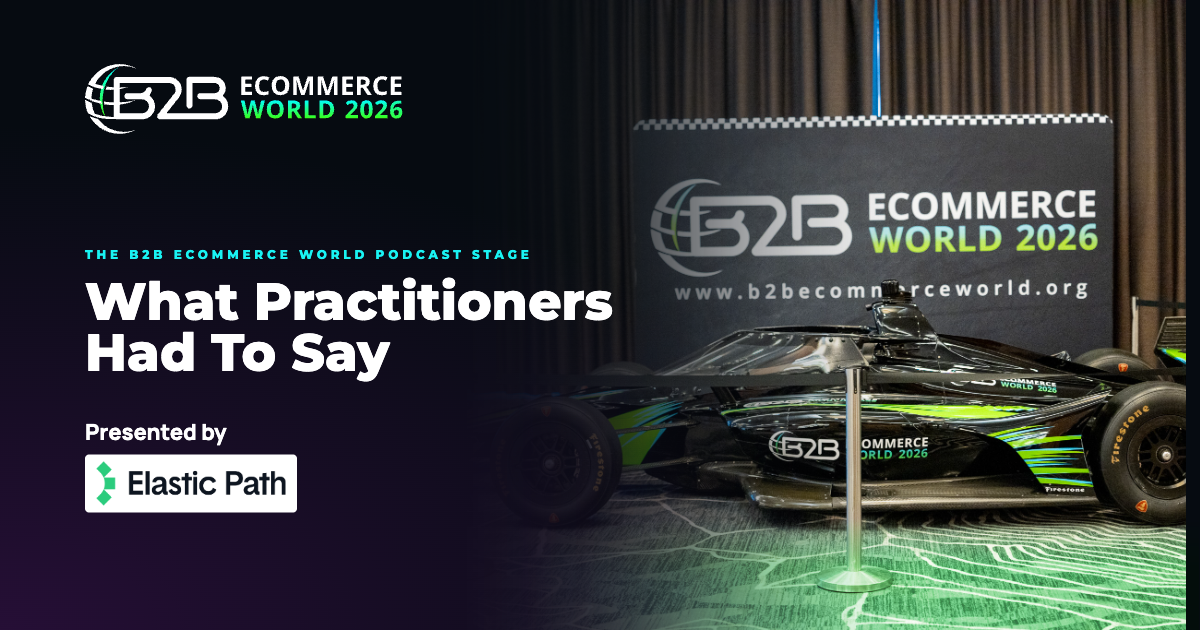
What B2B Practitioners Talked About on The Podcast Stage in Indianapolis
November 23, 2026

Operations Analyst & Chief of Staff · The B2B eCommerce Association
Over two days at B2B eCommerce World Americas in Indianapolis, practitioners from manufacturers and distributors, along with retail and technology leaders, sat down on The Podcast Stage, presented by Elastic Path, to talk about the work behind their digital programs. The guests came from very different businesses: medical devices, electronic test equipment, dental and animal health supplies, plumbing and HVAC wholesale, industrial hose and rigging, and a global manufacturer that sells through distributors and other channel partners. Every conversation went somewhere different, and each guest left the audience with something worth taking back to work. Here are the highlights.
Start small, prove it, then grow
Almost every practitioner described a first win that was deliberately small.
At Keysight, Tori Heibel, leads their global B2B eCommerce program. She said earlier attempts at eCommerce failed because individual business units built their own web stores with no shared strategy. When the company tried again in 2018, the team used a phrase it still remembers: "just enough commerce." They launched with a small set of products as a proof of concept, then expanded by product line, by country and by customer type.
Deirdre Peters, Director of Digital Experience at Boston Scientific took a similar approach at Boston Scientific, an $11 billion company that had no online sales when she arrived in 2019. Her original business case promised 3% incremental revenue. The program now delivers just under 20%. Her advice is to skip the billion-dollar return-on-investment pitch and start with a modest one. One early project cost $100,000 and returned $2 million to $3 million, which earned the trust to go bigger.
At Patterson, a distributor of dental and animal health products, Director of Data Governance Melanie Peterson picked a clear, measurable problem: products her sales reps can sell that customers can't see online. She calls these "sellable but not marketable." Starting with about 20,000 of Patterson's roughly 250,000 SKUs gives her team a defined set of products and a clean way to measure success.
The same idea showed up from the technology side. Elastic Path CEO Bryan House said the company's most successful customers pick one end-to-end process, get it right, and earn the trust of employees and customers before moving to the next one.
Product data moved from the back office to the center
Product data is the information behind every product: specs, images, descriptions, categories. For years it was the unglamorous part of eCommerce. This year, practitioners described other departments coming to them for it.
Krystian Hall works in item MDM at Winsupply, a wholesale distributor serving plumbers and HVAC contractors. When Winsupply modernized its systems, its local companies could suddenly see which items were missing images or spec sheets. They wanted that information for every product they sell. The result is a project to enrich 130,000 items in about nine months. Hall compared his team to a building's foundation: you can't put in carpet and curtains until it is in place.
Peterson described the same shift at Patterson. Getting approval for master data management took a long time, but the foundation now exists. The fulfillment and online teams are the ones asking for complete product data.
At 3M, Global eCommerce Manager Xavier Rio said product data quality and quantity remain the biggest challenge, even with AI. If an AI agent is fed poor product data, it gives poor answers, and that problem grows as product, customer and insight data get connected.
Heibel offered a useful counterpoint. Keysight already has strong product data. Its challenge is helping engineers find the right product and configuration on a very large site. Good data is the starting point, and helping customers find and trust it is the next step.
Preparing for buyers who aren't people
The biggest forward-looking theme was the arrival of AI agents as buyers. An AI agent is software that researches, compares or takes action on someone's behalf.
Peters said this keeps her up at night. A hospital may soon send an agent, not a person, to find product information, either through an AI chatbot or directly on Boston Scientific's site. She is still working out what data it will need and when the familiar website "front door" stops being the main way in.
Rio sketched what comes next. Right now manufacturers and distributors are each building their own agents. Soon those agents will need to talk to each other and to agents run by end customers' purchasing teams. Picture a large installer whose agent asks a distributor's agent for a quote on a highly technical 3M product. The distributor's agent may not have the technical depth to answer, so the manufacturer's agent has to supply it. Rio expects eCommerce manager roles to become "agent orchestrator" roles, managing how these agents work together.
Heibel is leading Keysight's agentic commerce roadmap, focused on a conversational agent that helps engineers choose the right setup. Her bar for trust is specific: the agent must never invent model numbers, and its answers must match what customers find on the site and hear from a sales rep. She also said she is still separating what is real from what is hype, and wanted to hear from other attendees about what is actually happening.
Change is mostly about people
All agreed that technology was rarely the hardest part.
Vicki Cantrell, founder of Vendors in Partnership, has watched about 40 years of retail transformation. She said change management is the most critical piece of any digital or AI program. It requires consistent, repeated messaging, and an understanding of what each person cares about and fears. Her line from the stage summed it up:
Everything is a business problem. Technology is only a lever. It's only a tool.
Peters said resistance usually has a reason. People may worry about losing influence or their role changing. At Boston Scientific she had support from the top and from her own level, but less in the middle, including finance partners who asked why a website would matter if customers were going to buy anyway. Proving value in small steps changed that conversation.
Matt Jungbauer, Global Director of eCommerce at 3M pointed to a gap inside large companies. His team is expected to adopt AI quickly, while legal, procurement and pricing are not always tasked with the same goals. Maturity, meaning how advanced a team is in its digital work, can differ between departments as much as between regions.
Mike Powers, Chief Digital and Technology Officer at employee-owned ARG Industrial, described the opposite situation from earlier in his career. At a previous company, he said, a major customer threatened to move its business if it couldn't order online, and he still faced friction with leadership. At ARG, the CEO and board treat digital transformation as seriously as opening a new branch. He added that employee ownership creates real energy for change, because people in the branches own part of the results.
Experiment first, then put guardrails around it
Powers gave the clearest account of how AI work matures. ARG started on the "go, go, go" end of the spectrum, building fast and testing in sandbox environments. In the 30 to 45 days before the event, the team stepped back to check whether what it had built was secure and to set internal policies on AI use, bringing in outside experts to audit the work. ARG also keeps a person involved in reviewing what AI produces, rather than letting it run unchecked.
Powers also showed how to drive adoption. ARG gave branch staff who manage customer inventory a login to the website. Customers now see ARG's own people using the platform, which has helped adoption both inside the company and with customers.
Rio and Jungbauer shared the same instinct. Experimentation came up all week: get hands-on, try things, and learn faster.
Knowledge that lives in people's heads
B2B companies rely heavily on experienced staff who know which product fits which job. Bryan House warned that this knowledge leaves when those people retire. The opportunity is to capture as much of it as possible in systems that every salesperson can use, while people keep the judgment calls.
Powers's team is moving in that direction. A team member has connected AI tools to ARG's core business system to produce quarterly customer reviews with one click.
Nobody has it all figured out
The most repeated message on the stage may have been the simplest. Peters said that for a long time she felt alone in her work, and that meeting peers who are solving the same problems has been worth everything. Cantrell closed her episode by telling the audience they are not alone and not behind, even though everyone assumes others know more. Hall said it helped to learn that Winsupply's product data struggles are an industry-wide challenge. Rio valued sharing failures as much as successes.
As AI changes how B2B buyers research and buy, time spent with peers who are working through the same questions has rarely been more useful. Co-hosts Jason Greenwood and Stacy Hanks gave first-time attendees a practical way into those conversations: bring three to five questions you're genuinely curious about, and ask them of everyone you meet.
In the end, the most practical lesson from The Podcast Stage was also the simplest: none of this gets figured out alone. Go out of your way to talk to your peers, ask good questions, and keep asking them of each other.
Watch the episodes
Jason Greenwood and Stacy Hanks: Every Product Has A Supply Chain
Vicki Cantrell: Technology Is Only A Tool
Mike Powers: From Go-Go-Go to AI Governance
Derek Gregg: Your AI Is Only As Good As Your Data
Tori Heibel: Just Enough Commerce
Bryan House: Before The Knowledge Walks Out The Door
Deirdre Peters: Ready For The Non-Human Buyer
Matt Jungbauer and Xavier Rio: Enter The Agent Orchestrator
Melanie Peterson: A Program, Not A Project
Krystian Hall: Data Is The Foundation